The Kitchen Designs That Add the Most Value to Australian Homes (And What Perth Buyers Actually Want)
Few home improvement decisions are discussed in terms of resale value as frequently as kitchen renovations, and few are misunderstood in the same consistent ways. The belief that every dollar spent on a kitchen renovation returns more than a dollar in property value is not universally true. The belief that installing a kitchen to the highest possible specification always produces the best financial outcome is equally wrong. The real relationship between kitchen investment and property value is more nuanced, and understanding it properly helps Perth homeowners make renovation decisions that serve both their lifestyle and their asset.
What drives kitchen value in the Australian residential property market is a combination of functional quality, design relevance, and the alignment between the kitchen’s standard and the overall standard of the property. A kitchen that is disproportionately elaborate for a modest home adds less value than the same investment made on a property where the kitchen quality reflects the home’s broader quality level. A kitchen that is clearly dated, or functionally inadequate for contemporary household use, subtracts value in ways that are visible to any experienced buyer.
Perth’s property market has its own specific buyer preferences that shape which kitchen characteristics generate the strongest value response. Understanding these preferences is the most practical guide to kitchen renovation investment decisions in this market.
What Perth Property Buyers Are Looking For in a Kitchen
Perth residential buyers, whether looking at entry-level homes in the outer suburbs or premium properties in coastal or riverside locations, consistently nominate the kitchen as one of the top two or three factors in their purchasing decision. The specific things they are looking for vary by price point, but some preferences are consistent across the market.
Functional quality at appropriate scale. Buyers respond strongly to kitchens that feel generously sized for the household they will support, with adequate bench space, practical storage, and an island or peninsula that creates a social cooking environment. Kitchens that feel cramped, that lack adequate storage, or that have a layout that creates obvious workflow problems are noticed and discounted, regardless of the quality of individual materials and finishes.
Updated fixtures and appliances. Dated tapware, old tile splashbacks, laminate benchtops in tired condition, and appliances from a previous decade are among the most common buyer objections to existing kitchens. Updating these elements has a stronger value impact per dollar spent than most major structural changes to a kitchen, particularly in the mid-market where buyer expectations are calibrated to functional modernity rather than luxury specification.
Clean, contemporary presentation. Buyers in the Perth market respond well to kitchens that feel current without being aggressively fashionable. A kitchen that will date obviously within five years is a liability at resale, not an asset. One that looks fresh, well-designed, and likely to remain appealing for years to come is an asset.
The Hampton Kitchen and Its Enduring Value Profile
The Hampton kitchen design has maintained a strong value position in the Australian market for longer than most design trends do. The reasons are well-grounded in what buyers actually respond to when they walk into a kitchen.
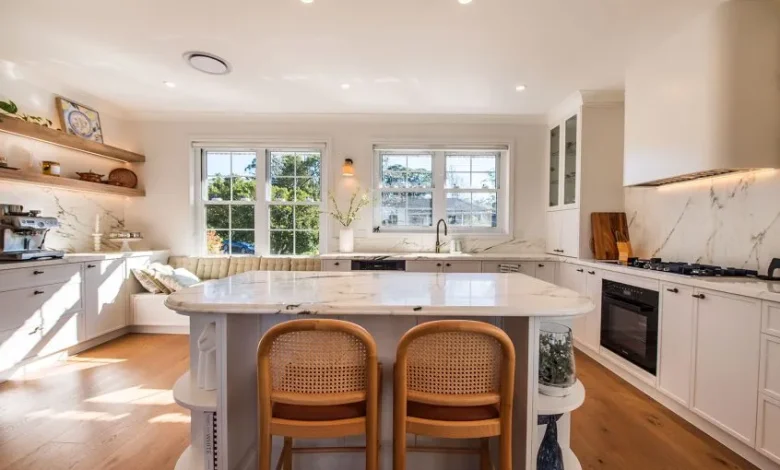
Hampton style kitchens read as quality. The shaker door profiles, painted finishes, marble or marble-look stone benchtops, and brass or chrome hardware combinations communicate craftsmanship and material quality in ways that more minimal designs sometimes do not to the average buyer. A buyer who does not have a strong personal design vocabulary responds intuitively to a Hampton kitchen as a high-quality, well-made space in a way that they may not respond to an equally well-made but more austere minimal kitchen.
For property owners and investors renovating for the Perth market, the Hampton kitchen design approach has consistently performed well in the resale context because of this broad buyer appeal. It is not the most fashionable choice at any given moment, but it is the choice most likely to read as quality and desirability to the widest possible buyer pool.
The specific Hampton features that add the most resale value are those visible at first inspection: the benchtop quality, the door profile and finish condition, the tapware, and the island configuration. These are the elements buyers assess in the first sixty seconds of seeing a kitchen, and they are the elements where investment pays most reliably.
Kitchen Design Styles and Their Value at Different Price Points
The relationship between kitchen design style and resale value is also a function of the price point at which the property sits in the Perth market.
Entry and mid-market Perth properties benefit most from kitchens that are functional, updated, and clean rather than strongly styled. At this price point, buyers are primarily concerned with whether the kitchen works, whether it needs immediate work, and whether it will serve their household comfortably. A well-executed contemporary kitchen with quality appliances, a solid stone benchtop, and current tapware serves these buyers more effectively than an ambitious design statement that may not suit their specific taste.
Premium Perth properties in coastal, riverside, or prestige suburban locations attract buyers with more developed design vocabularies and stronger personal preferences. At this price point, a kitchen that feels generic or compromise-level is a problem. The full range of kitchen design styles from Hampton through to contemporary and Scandinavian all have viable premium market positions, provided they are executed to a quality standard that matches the property’s overall premium.
Investment properties and units benefit from kitchens that are durable, low-maintenance, and appealing to the broadest possible tenant market rather than strongly styled. This is a context where the investment in a highly designed kitchen is unlikely to return its cost through rental premium, and where practical, well-specified modernity serves the investment better than stylistic ambition.
The Renovation Decisions That Consistently Improve Resale Value
Within the kitchen renovation scope, several specific decisions consistently have the strongest effect on resale value per dollar invested.
Benchtop upgrade. A stone benchtop, whether natural or engineered, is the single most visible material quality indicator in a kitchen. Replacing a laminate or dated tile benchtop with a quality stone surface has a disproportionate effect on a buyer’s perception of the kitchen’s overall quality. The investment is modest relative to the total renovation cost and the value impact.
New tapware and fixtures. Quality tapware in a current finish profile transforms the look of an existing kitchen at relatively low cost. This is one of the highest-return investments available in a partial kitchen update, and it is easily combined with an undermount sink replacement that further improves the kitchen’s presentation.
Cabinet door fronts and hardware. In kitchens where the cabinet carcase is structurally sound, replacing the door fronts and drawer fronts rather than the entire cabinet structure is a cost-effective way to update the kitchen’s design direction. This approach can achieve the visual impact of a new kitchen at a significantly lower cost, particularly when combined with a benchtop and tapware update.
Appliance updates. Replacing dated appliances, particularly a cooktop, oven, and rangehood, makes a significant visual and functional improvement to a kitchen at a cost that is typically recoverable in the property’s sale price. In the mid-market particularly, visibly updated appliances remove a buyer’s concern about imminent replacement costs.
What Diminishes Kitchen Value at Resale
Understanding what subtracts value is as useful as understanding what adds it.
Overly personalised design choices. A kitchen designed with a specific homeowner’s personal taste as the primary reference creates a value risk at resale if that taste is niche or unconventional. Highly personalised colour choices, unusual material combinations, or design references that appeal strongly to some buyers and not at all to others reduce the breadth of the buyer pool. Maintaining design choices within a range that has broad appeal, even when doing so involves some compromise of personal preference, is a sound approach to kitchen renovation for resale.
Design that is obviously dated. Kitchens that were contemporary at the time of renovation but have since become strongly associated with a particular era of design taste are a consistent buyer objection. Design choices that are likely to date within five to ten years are a poor investment for any homeowner with a medium-term horizon.
Quality mismatches within the kitchen. A premium island benchtop combined with budget appliances, or high-quality cabinetry combined with dated tapware, creates a value impression below what the most expensive element implies. Internal quality consistency matters. The weakest elements set the impression level at which the kitchen is assessed.
Working with a Perth Kitchen Designer Ahead of Resale
For Perth homeowners who are renovating with a view to eventual sale within several years, the most valuable design service is one that aligns the kitchen’s quality and design direction with the specific segment of the Perth market the property will target at sale.
Experienced kitchen designers and showrooms with strong local market knowledge can advise on which design directions have the strongest current buyer appeal in the relevant price bracket, which materials and specifications are expected versus premium in the target market, and which scope of renovation delivers the best value outcome for the specific property.
For Perth homeowners exploring this kind of market-informed design advice, visiting a Perth kitchen showroom with the property and its target market context in mind, rather than simply browsing for inspiration, produces the most actionable guidance.
Conclusion
Kitchen renovations that add genuine value to Perth properties are those aligned with what buyers in the relevant market segment actually respond to, executed to a quality standard consistent with the property’s overall level, and designed with sufficient restraint to remain appealing to a broad buyer pool rather than a narrow one.
The Hampton kitchen has earned its strong value position in the Perth market through exactly these attributes: broad buyer appeal, visible quality signals, and a design direction that has proven its durability across many market cycles. Other well-executed design directions can achieve comparable value outcomes provided they are executed with equal quality and equal attention to the breadth of their buyer appeal.
The investment in getting the kitchen right, informed by the Perth market rather than by personal preference alone, consistently delivers the best combination of lifestyle value now and resale value later.